
★★★★★
My overriding memory of studying Chekov at university is that the basic message in his plays is that life would be so much better for the characters, if only they could move to Moscow. Life in the country is quiet and boring. And to be honest, that is a pretty good summation of Chekov.

Emilia Clarke (Nina)
I wasn’t too familiar with The Seagull and purposely didn’t look into it before going to see the play. I knew it was a modern version – script by Anya Reiss – and had seen some production photos online.
My first thought upon entering the theatre was that it reminded me of Kallax cube from IKEA. There was an actor lying on the floor, a couple of stacks of green plastic chairs at the back, and music playing. Gradually over the 30 mins leading up to the start the actors came onstage through the auditorium – this was a box on stage with no entry from the wings! Minimalist was the thought that came to mind.

Emilia Clarke (Nina), Indria Varma (Irina), Daniel Monks (Konstantin), Tom Rhys Harries (Trigorin)
Chekov was a playwright who fitted into the Naturalist movement. His work could be seen as a reaction against the melodrama of the time where plays focused on the luxuries and aspirations of life with elaborate upper class drawing rooms as a common setting. Instead Chekov focused on the minutiae of life with his characters bored and trapped in their dull small existences – hence the desire of many characters to go to Moscow where life is more exciting. What this version of the play has done – both in the script and the direction (Jamie Lloyd) – is present us with characters who are trapped in a box – or their lives. It is only during Act 2 that this box opens up a bit.
The main draw is of course Emilia Clarke (of Game of Thrones fame) as Nina. This is her West End debut and she has been nominated for The Stage Debut Award for her performance. Her portrayal is spot on as she convincingly portrays this naive, romantic actress who longs for a career on the stage. When we meet Nina in Act 2 the reality of life has become clear to her and there is a real shift in Clarke’s portrayal.
However, I did feel that the stand out performance came from her fellow Game of Thrones actor, Indria Varma as Irina. Right from the start of the play we see a jaded grand actress who is far from complimentary about the play they have just watched, written by her son Konstantin (Daniel Monks). Indeed in this version she is the driving force as the play begins – a departure from the original. Indria totally commands the stage and with a mesmerising performance of a selfish mother, totally obsessed with her young lover, Trigorin (Tom Rhys Harries).

Indria Varma (Irina)
Daniel Monks gives another standout performance as playwright Konstantin. If you are looking for a spot on performance of a tormented writer then you don’t need to look any further than this. It was also wonderful to see the diversity in this casting as Konstantin is not a disabled character, but through the casting of Daniel – who is disabled – the character takes on a different dimension.
There were no real weak links amongst this cast, but I do want to acknowledge Sophie Wu as Masha. She seemed to embody the depressive element of life and a character that accepts that this is what life is like. This is classic Chekov.
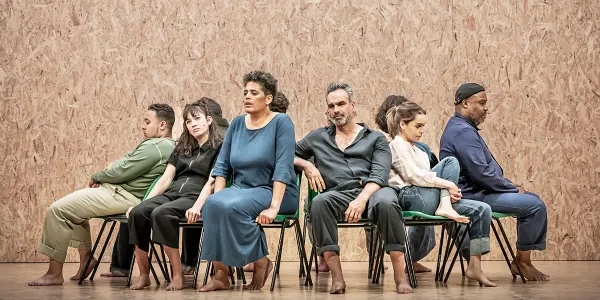
The Cast
If you are looking for traditional 19th century Russian drama then this is probably not the production for you. But it was a riveting 2 hours and 30 mins where not much happens, but at the same time so much is explored. It was a perfect reminder of the power of theatre and to quote the play, “We need the theatre, couldn’t, couldn’t do without it. Could we?”
The Seagull is at the Harold Pinter Theatre, London until 10th September
Photos © Marc Brenner
 Act 1 Beginners